
FlowDevs
Constrain the Problem, Not the Intelligence
Effective AI prompting requires constraining the problem, permissions, and success criteria, not the intelligence. Learn how to empower your AI agents.
Aug 1, 2026 · 4 min read
Read more
May 20, 2025 · 3 min read · Justin Trantham
Microsoft's Phi-4-mini-reasoning shows strong on-device reasoning power but quirky conversational behavior, revealing how design choices shape user experience.
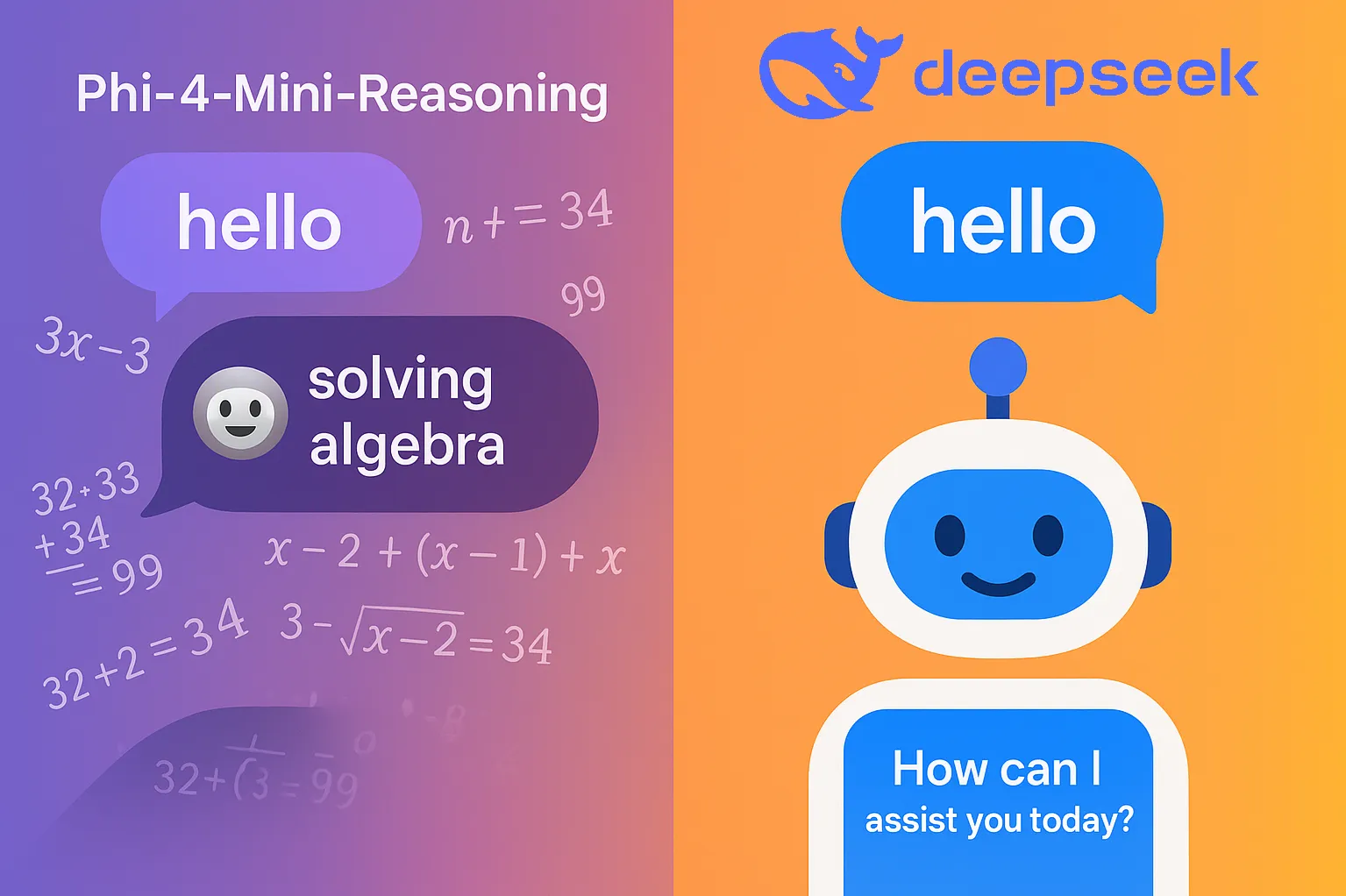
"hello"
Phi‑4‑mini‑reasoning:
🤖
Okay, so I need to solve the problem where the sum of three consecutive integers is...
and off it lurches into a full algebra lecture.
"hello"
DeepSeek:
🙂
Hello! How can I assist you today?
That one‑liner captures the gulf between Microsoft's new Phi‑4‑mini‑reasoning and the open‑source darling DeepSeek better than any benchmark chart. One sees a greeting as a math quiz and immediately dumps its entire chain of thought on your screen; the other does the simplest, most human thing possible: it greets you back and waits.
Phi‑4‑mini‑reasoning was born to win classroom‑style reasoning tests on low‑power devices. Microsoft trained it almost entirely on synthetic, "textbook‑quality" data that emphasises step‑by‑step logic. On Hugging Face, the model card proudly highlights that focus on math‑dense corpora great for proofs, not so great for pleasantries. (Hugging Face)
Because the raw checkpoint streams every internal step, devs are expected to wrap or truncate its answers before users ever see them. If you skip that guardrail as my "hello" prompt did the model happily thinks out loud. Edge's new on‑device AI APIs showcase the same 3.8 B‑parameter model for web apps, but Microsoft still treats it as a developer primitive, not a polished chatbot. (The Verge)
DeepSeek's philosophy is almost the mirror image. Since its first Mixture‑of‑Experts release in late 2024, the project has chased broad usability over tiny‑footprint benchmarks. The current DeepSeek V3 mixes real‑world web, code and multilingual data, then layers on RLHF passes that reward brevity and intent‑recognition. The result: a model that notices a plain greeting and simply greets. (Helicone.ai)
DeepSeek's alignment cycle is fueled by an active community and big‑name cheerleaders Nvidia's Jensen Huang even called Chinese labs like DeepSeek "world‑class" this year, a shout‑out that drew fresh contributors and use‑cases almost overnight. (Business Insider) Phi‑4‑mini's audience is smaller and more specialised, so its misfires linger longer in the wild.
Yes, Phi ships a roomy 128 K token context, but that doesn't help when the very first token is "hello." Without prior context it defaults to its strongest instinct explain a maths problem whereas DeepSeek's policy nudges the model to clarify the user's intent before volunteering solutions.
Wrap the raw model. A simple post‑processor that strips chain‑of‑thought or crops after the first assistant‑role block makes Phi‑4‑mini far less jarring.
Choose by interaction style, not parameter count. If your UX revolves around tight, conversational turns, DeepSeek (or any similarly aligned model) will feel smarter even if it's 100× larger.
Use Phi where determinism matters. For offline calculators, embedded tutors, or function‑calling demos, its deterministic reasoning is a feature, not a bug.
In short, Phi‑4‑mini excels at thinking; DeepSeek excels at listening first. Decide which matters more for your users and always start your test script with a simple "hello."
Happy building!
Effective AI prompting requires constraining the problem, permissions, and success criteria, not the intelligence. Learn how to empower your AI agents.
Aug 1, 2026 · 4 min read
Read moreStop copy-pasting standard code snippets. Learn how AI coding agents use system context to automate workflows, fix bugs, and build better software.
Jul 30, 2026 · 5 min read
Read moreA case study on why fixed UI is becoming less important and how runtime-rendered interfaces can revolutionize operational software and business workflows.
Jul 30, 2026 · 7 min read
Read moreWe build the systems described here. A short call is usually enough to tell whether it's worth building.