
Automation
From driver CDs to dots
A brief look at using dot and FlowRMM to find, verify, and install a graphics driver, showing how conversational AI assists in everyday IT operations.
Oct 4, 2026 · 1 min read
Read more
October 17, 2026 · 5 min read · Justin Trantham
Discover how FlowDevs merged nearly 200 PRs in 48 hours using a recursive engineering improvement loop, turning human direction and AI into reliable systems.
The conversation around artificial intelligence in software engineering has spent too long stuck on a basic question. People are still arguing about whether a model can write a script. We are focused on a much more interesting operational reality: how to accelerate the entire delivery loop. When you connect human direction to agent implementation and rigorous automated testing, the result is sheer velocity. In a recent window of just 48 hours, our team merged nearly 200 pull requests into the FlowRMM repository.
Those numbers are not a parlor trick. We build the applications your business runs on, and building them faster means shipping reliable client outcomes sooner. We do this by treating AI as an interface and a source of labor, not an autonomous magic wand. We operate a recursive improvement loop where implementation feedback becomes the next feature or bug fix. It requires strict guardrails, but when it works, a small team can ship an ambitious amount of code.
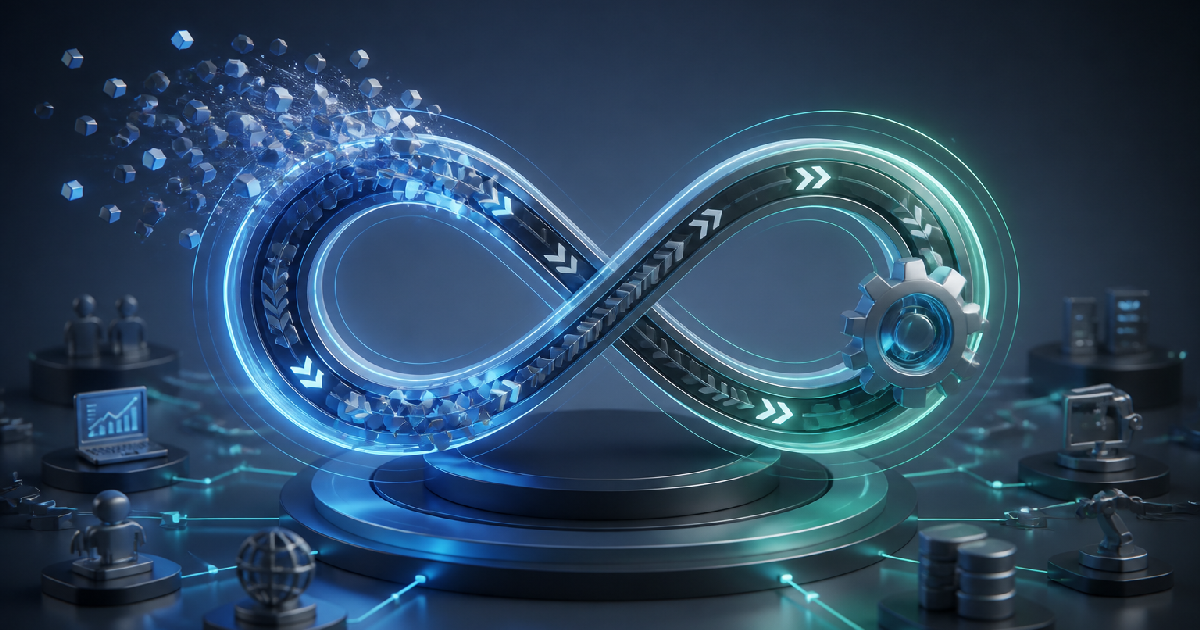
When we say recursive improvement loop, we do not mean a sentient model rewriting its own weights or an unbounded autonomous system running wild in production. That is science fiction. We mean a tightly controlled engineering feedback loop.
Human engineers set the direction and define the operational constraints. Agents implement the code and cross-check the work. Our required tests and protected merge queues remain fully intact. The work goes to the lab before it goes to production. Every time an agent tries to implement a feature and fails a test, that failure feeds right back into the loop as the next bug to fix. Humans maintain visibility and accountability, while the agents do the heavy lifting of writing and refactoring.
We believe in proof over promises. Between October 15 and October 17 of 2026, the FlowRMM repository saw 197 merged pull requests in 48 hours. Looking at just the preceding 24 hours, we merged 118 pull requests and created 124.
To be clear, those are not 197 brand new features. That count includes bug fixes, dependency updates, and version bumps alongside major feature work. But the feature work we merged is substantial and strictly focused on approved endpoint actions and accountability.
Recent merges include approved Windows patch installation and remediation for known-exploited Windows vulnerabilities. We shipped evidence collection for antivirus, firewall, and encryption status. We added per-client remote consent, requiring a second admin approval to loosen those restrictions. On the FlowPSA side, we merged the purchasing lifecycle and receiving processes into client assets. We also merged Linux package manager patching and read-only Pax8 subscription reconciliation, though those features still have live validation ahead.
Speed is useless if the system breaks in production. Our agents help us write tests, and those tests catch flaws before they impact a real business.
Here is a concrete example. Our tests found a flaw where a runbook script could be changed while a prior autonomy approval remained in place. That is a security risk. The fix securely binds the approval to the specific guide and the actual scripts being run. Our regression tests failed before the fix and passed after the fix, fully backed by memory and PostgreSQL test coverage.
Another real labchat replay drove immediate fixes to false Finished states, reconnection issues, and duplicate replies. We do not claim every single pull request received independent agent verification or that all live acceptance is complete. We rely on the tests, the lab, and our operational process.
Most companies do not need another disconnected feature. They need coherent systems. FlowRMM handles the approved endpoint actions, while FlowPSA manages the customers, assets, purchasing, and business context.
The goal is to connect these systems so IT work is always traceable to customer business needs. The outcome for our customers is fewer repeated failures and much clearer permissions. We do not fabricate measured cost savings or invent ROI testimonials. We just build reliable workflows.
On October 17 at 00:36 UTC, we executed a successful lab release. This verified our portal deployment, database migrations, licensed identity handling, endpoint convergence, and PSA lab integration, alongside shared-view and public MCP checks.
Because this was a portal-only release, we skipped live remote-input, media, and guest acceptance tests for now. The newest merges postdate that release. A successful lab release is verified, but new work is still under live validation. Not all 197 features are deployed, and we make no claims of production completion just yet.
No. Engineers define the architecture and set the direction. Agents assist in writing the implementation and tests. Everything must pass our standard merge queues and tests.
Automation is a capability we use to make work repeatable. Humans still hold the authority, set permissions, and review the outcomes.
They are merged into the repository but still require live validation. We test extensively in the lab before rolling anything out to production environments.
Speed comes from strict guardrails. Tests must pass. The merge queue is protected. If a test fails, the code does not merge.
Pushing nearly 200 pull requests in two days is fun for our engineering team. It proves our feedback loop is fast. But velocity alone is not the goal. The actual point is building the application that makes your work understandable, repeatable, and easier to operate.
We are a small team committed to ambitious delivery. We replace broken handoffs with connected systems. If you run a managed service provider or an IT team and you want to see how approved human and agent operations can change your business, we should speak.
Visit https://flowdevs.io/ to reach out. Talking is free.
We build the systems described here. A short call is usually enough to tell whether it's worth building.