
FlowDevs
Constrain the Problem, Not the Intelligence
Effective AI prompting requires constraining the problem, permissions, and success criteria, not the intelligence. Learn how to empower your AI agents.
Aug 1, 2026 · 4 min read
Read more
October 28, 2025 · 7 min read · Justin Trantham
From the PPCC keynote: This is the "builder's moment." See why embedded AI agents have 80% adoption and how Power Platform pros can lead the future of work.
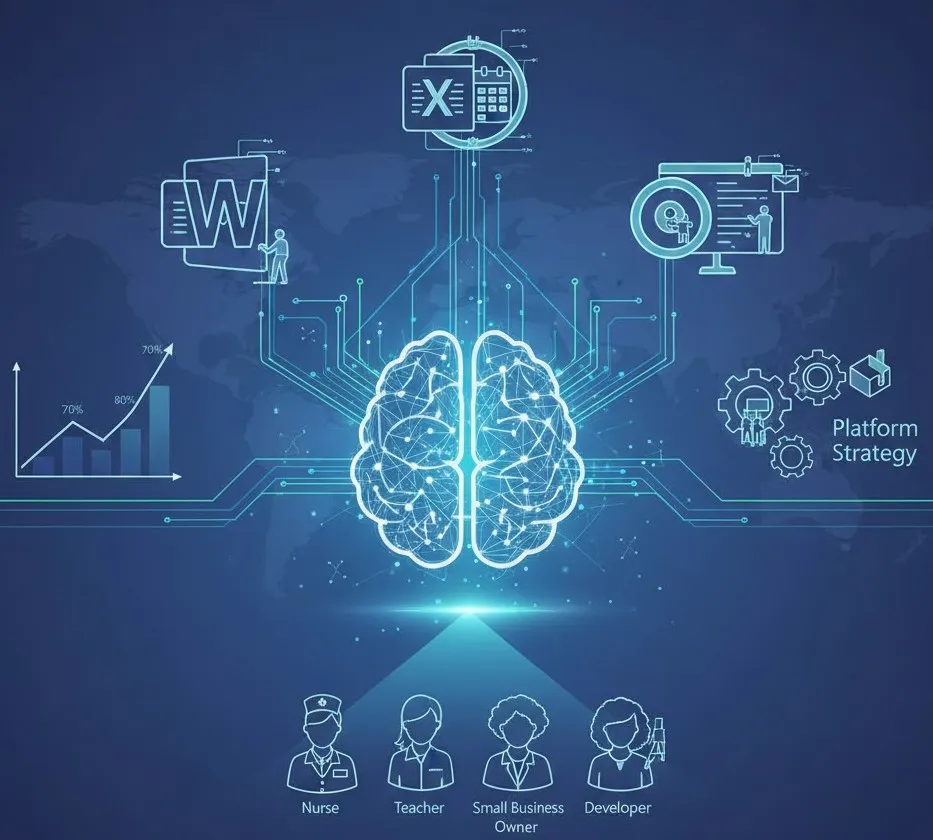
The workplace is undergoing a fundamental transformation. According to recent insights from Microsoft's analysis of LinkedIn's economic graph, a real-time digital representation of the global professional landscape, the nature of work itself is evolving at an unprecedented pace. For automation companies and developers, this presents both challenges and extraordinary opportunities to reshape how billions of professionals accomplish their daily tasks.
The data reveals a striking reality: over the past three years, the skills required for the average job have changed by 25% due to AI integration. Even more significantly, this number is projected to reach 70% by 2030. This means that even if professionals aren't changing jobs, their roles are fundamentally changing around them.
This transformation is particularly pronounced among entry-level workers, who are actively adding AI skills to their profiles at higher rates than any other demographic. These professionals understand that AI literacy isn't optional, it's essential for career survival and growth in the modern workplace.
One of the most important discoveries in AI adoption patterns reveals why many standalone AI tools fail while embedded solutions thrive. Embedded AI solutions achieve adoption rates of 60% to 80%, while standalone tools suffer up to a 75% drop-off due to workflow disruption. This insight is revolutionary for automation companies developing AI solutions.
The key principle is clear: AI works best when it's woven into everyday workflows rather than existing as separate applications that disrupt established work patterns. This understanding has fundamentally shaped how leading technology companies approach AI integration.
The most successful AI implementations follow a framework centered around what Microsoft calls the "copilot brain", an intelligent system that continuously learns, understands user roles, priorities, and context across multiple applications. This brain knows what users are working on, what matters most to them, and provides multiple models with deep context and constant improvement.
The magic happens when this intelligent core is elegantly married with the productivity applications where billions of people already do their work, Word documents, PowerPoint presentations, Excel spreadsheets, and Outlook emails. This creates a vibrant AI ecosystem that enhances rather than disrupts existing workflows.
Office Agent represents a breakthrough in automated content creation. Users can request complex deliverables like comprehensive presentations about frontier firms in the age of AI and automation, complete with insights from research reports and strategic roadmaps. The agent uses chain-of-thought reasoning, allowing users to specify presentation focus, target audience, slide count, and design themes.
The results are remarkable, professionally formatted presentations with appropriate icons, fonts, and layouts that would typically require hours of manual work. This isn't just automation; it's intelligent content creation that understands context and business requirements.
Agent mode in Word processing represents a hands-off approach to document improvement. Users can provide comprehensive instructions, replace lists with tables, update introductions with bulleted summaries, change heading colors, and watch as the AI autonomously implements multiple edits simultaneously.
This autonomous capability transforms document editing from a tedious manual process into an intelligent collaboration where users provide strategic direction while AI handles tactical execution. Users maintain control by reviewing and selecting which changes to keep or discard.
Excel's agent capabilities showcase AI's potential for complex data manipulation and analysis. With simple natural language prompts, users can request comprehensive data quality reports that automatically highlight errors in yellow and provide suggested fixes on separate sheets.
More impressively, agent mode can execute complex multi-step operations: calculating net profit columns, combining name fields, creating hyperlinks from email addresses, and cleaning up data structures, all from a single natural language instruction.
The Facilitator agent acts like a virtual colleague in meetings, automatically managing agendas, tracking discussion items, and creating actionable documents based on meeting content. When participants request deliverables like timeline documents for upcoming events, Facilitator generates comprehensive plans grounded in the meeting's context without requiring detailed specifications.
This capability transforms meetings from discussion forums into action-generating engines where ideas automatically become structured deliverables and task assignments.
The Researcher agent exemplifies AI's potential for complex information synthesis. Using advanced models like GPT-5 or Claude, it can generate comprehensive customer briefings that include business overviews, strategic priorities from recent disclosures, security assessments, rollout strategies, and competitive analyses.
What traditionally requires 4-6 hours of preparation time for sales professionals becomes available instantly with rich, interactive content that pulls from multiple authoritative sources. The agent provides complete source attribution, ensuring transparency and enabling verification.
Notebooks function as personalized collections of AI artifacts, similar to how professionals use traditional note-taking applications for career documentation. However, these notebooks can generate podcasts from content, create interactive charts, and provide focused analysis based solely on the curated information within each notebook.
This focused grounding approach enables precise analysis on specific topics while maintaining clear boundaries around data sources and context.
The platform enables non-technical users to create sophisticated agents using natural language descriptions. Users can specify agent purposes, assign knowledge bases from SharePoint sites, and deploy functional AI assistants within minutes.
This democratization of agent creation means that every team, department, or organization can develop specialized AI tools tailored to their unique workflows and data sources without requiring programming expertise.
Modern AI systems implement sophisticated security labeling for responses that draw from secure data sources, ensuring that sensitive information is clearly identified and properly handled. Additionally, personalization features allow users to set preferences, such as currency conversions or formatting standards, that persist across all AI interactions.
These capabilities ensure that AI assistance becomes truly personalized while maintaining enterprise-grade security standards.
The most significant insight for automation companies is the platform approach to AI development. Rather than building monolithic solutions, successful AI implementations create ecosystems where:
Core intelligence (the "brain") provides consistent learning and context
Multiple specialized agents handle specific use cases
Custom agents address unique organizational needs
Everything operates within existing workflow applications
This approach allows thousands of use cases to flourish while maintaining consistency and quality across the entire experience.
For automation companies and developers, this transformation represents an unprecedented opportunity to:
Build agents that integrate seamlessly with existing productivity workflows rather than requiring new application adoption
Focus on specific use cases while leveraging platform capabilities for core AI functionality
Serve underrepresented professional segments like nurses, teachers, and small business founders who need AI assistance tailored to their unique challenges
Create industry-specific solutions that understand domain expertise and regulatory requirements
We're entering what many consider the "builder's moment" in AI development. The tools and platforms exist to create AI agents that can truly transform how professionals work. The key is building solutions that respect existing workflows, understand professional contexts, and provide genuine value rather than technological novelty.
The future belongs to automation companies that can put capable, trusted AI in the hands of the world's professionals, AI that knows their data, respects their privacy, and understands their professional goals. When implemented thoughtfully, these solutions don't just improve efficiency; they enable professionals to do the best work of their lives while opening up opportunities once thought impossible.
The transformation is already underway. The question for automation companies isn't whether AI will reshape work, but whether they'll be part of building that future or watching it happen from the sidelines.
Effective AI prompting requires constraining the problem, permissions, and success criteria, not the intelligence. Learn how to empower your AI agents.
Aug 1, 2026 · 4 min read
Read moreStop copy-pasting standard code snippets. Learn how AI coding agents use system context to automate workflows, fix bugs, and build better software.
Jul 30, 2026 · 5 min read
Read moreA case study on why fixed UI is becoming less important and how runtime-rendered interfaces can revolutionize operational software and business workflows.
Jul 30, 2026 · 7 min read
Read moreWe build the systems described here. A short call is usually enough to tell whether it's worth building.