
FlowDevs
Constrain the Problem, Not the Intelligence
Effective AI prompting requires constraining the problem, permissions, and success criteria, not the intelligence. Learn how to empower your AI agents.
Aug 1, 2026 · 4 min read
Read more
October 28, 2025 · 6 min read · Justin Trantham
Transform operations with the process intelligence revolution in Power Automate Process Mining. Learn how AI-powered process mining moves enterprises from operational chaos to intelligent automation.
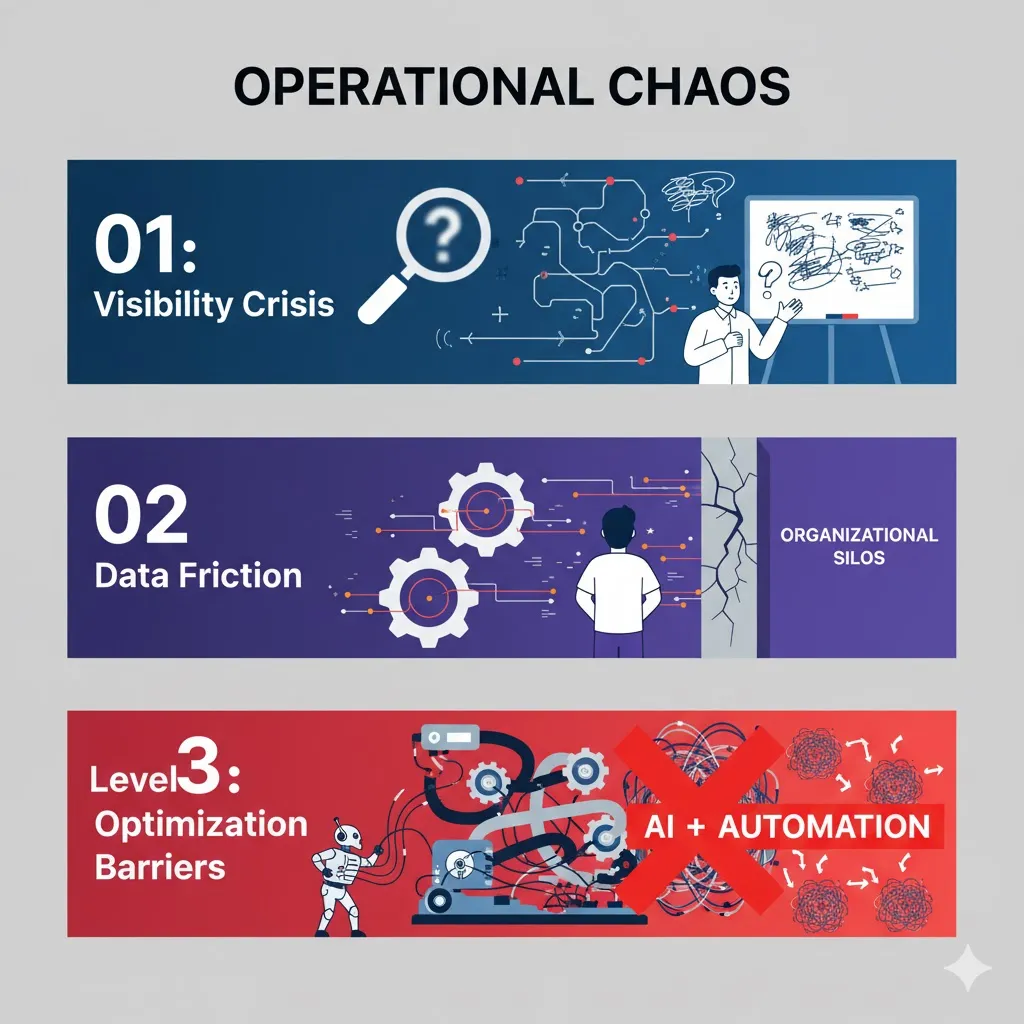
Today's enterprise leaders face an unprecedented challenge: implementing AI and automation technologies on top of poorly understood business processes. The result? Multiplied chaos instead of optimized efficiency. However, forward-thinking organizations are discovering that process intelligence, the evolution of traditional process mining enhanced with AI capabilities, provides the foundation for successful digital transformation.
At its core, every business operation is fundamentally a process. Whether managing daily workflows or executing strategic initiatives, organizations that master process intelligence gain competitive advantages through data-driven decision making, eliminating operational friction, and implementing automation that amplifies efficiency rather than confusion.
Most organizations operate under dangerous assumptions about their processes. What appears as a straightforward purchase-and-pay workflow with clean boxes for purchasing, logistics, and finance often reveals extraordinary complexity when examined through process mining. A recent analysis of emergency medical services, handling 200,000 yearly calls across 1,000+ coverage divisions, discovered over 1,000 process variations despite having only 13 core activities.
This complexity manifests in three critical levels of operational chaos:
Level 1: Visibility Crisis - Teams make decisions based on assumptions rather than data-driven insights, turning strategic planning into educated guesswork.
Level 2: Data Friction - Departments execute procedures in isolation without understanding cross-functional impacts, creating organizational silos that prevent optimization.
Level 3: Optimization Barriers - Organizations implement AI and automation on broken processes, exponentially multiplying inefficiencies instead of creating streamlined operations.
A Netherlands-based smart citizen services organization transformed their operations by implementing process intelligence across elections management, citizen feedback systems, and permit tracking. Results included:
10-minute audit processing time (previously requiring hours or days)
20% improvement in permit processing efficiency
Continuous monitoring capabilities for all citizen interactions
Enhanced transparency across 17 municipal jurisdictions
An enterprise IT organization processing over 100,000 tickets annually applied process mining to incident management workflows, achieving:
15% reduction in mean time to resolve incidents
Daily data regression capabilities for continuous improvement
Real-time visibility into resolution patterns and bottlenecks
Automated escalation procedures based on process intelligence
The most compelling example involves paramedics operations where process optimization directly impacts human lives. By applying process intelligence to emergency response procedures, from 911 calls through dispatch, arrival, treatment, and transport, the organization optimized:
Time-to-dispatch policies for faster emergency response
Process deviation identification to maintain quality standards
Response procedure streamlining across geographic coverage areas
Critical performance metrics tracking in real-time
The outcome extends beyond operational efficiency to improved patient satisfaction, enhanced paramedic job performance, and ultimately more lives saved through optimized response times.
Traditional process mining approaches force complex, multi-object processes into simplified linear flows, often losing critical context and creating misleading process representations. The next generation of process intelligence embraces two revolutionary innovations:
Rather than flattening complex workflows into artificial case IDs, object-centric process mining maintains natural relationships between multiple process objects. In healthcare scenarios involving patients, treatments, room assignments, and blood tests, this approach reveals true process interdependencies without creating artificial loops that don't exist in reality.
Real-world healthcare analysis demonstrates this power: examining 112 patients through object-centric mining reveals that room assignment to patient discharge averages five days, while blood test processing requires eight hours from admission. This granular visibility enables targeted improvements that directly impact patient care quality and operational efficiency.
The emergence of "agentic process mining" represents a paradigm shift toward self-correcting, adaptive processes. This approach integrates AI agents throughout the process intelligence pipeline to achieve two critical objectives:
Self-Healing Processes: Enterprise applications embedded with process intelligence that automatically detect deviations, identify root causes, and trigger corrective actions without human intervention.
Accelerated Time-to-Value: Traditional process mining implementations requiring weeks or months now compress to hours or days through AI-powered analysis and insight generation.
Modern process intelligence implementations rest on three foundational pillars:
Standardized access to process mining capabilities, including bottleneck analysis, root cause identification, and process simulation, that integrates seamlessly across enterprise technology stacks.
Natural language interactions with process data that eliminate the traditional gap between complex analysis and actionable business insights. Business users query process performance without requiring deep technical expertise, while automation developers access real-world process behavior during application design.
Always-on intelligent systems that continuously monitor process performance, proactively identify optimization opportunities, and perform root cause analysis rather than simply reporting symptoms like SLA breaches.
Successful process intelligence deployment follows a cyclical methodology that ensures continuous improvement:
Data Foundation: Establish case IDs, activity tracking, and comprehensive timestamp logging across all process touchpoints
Discovery Phase: Analyze actual process execution versus intended workflows, revealing hidden variations and bottlenecks
Transformation: Apply insights to optimize processes before implementing automation solutions
Continuous Monitoring: Implement ongoing measurement and adjustment to prevent regression to previous inefficiencies
This flywheel approach transforms process mining from periodic analysis into continuous optimization capability.
Organizations implementing AI and automation without process intelligence foundations risk amplifying existing inefficiencies at machine speed. However, enterprises that establish process intelligence capabilities first gain:
Data-driven decision making replacing assumption-based planning
Cross-functional visibility eliminating departmental silos
Intelligent automation that multiplies efficiency rather than chaos
Continuous improvement capabilities as organizational competencies
Competitive advantages through operational excellence
The convergence of object-centric process mining and agentic AI signals a fundamental shift toward intelligent, self-managing enterprise processes. Organizations adopting these capabilities gain unprecedented process visibility while dramatically accelerating improvement identification and implementation.
As these technologies mature, enterprise applications will automatically optimize themselves based on real-time process intelligence, eliminating traditional delays between problem identification and corrective action. The result: more resilient, efficient, and adaptive business operations that continuously evolve to meet changing requirements.
For automation companies and process improvement professionals, these innovations represent opportunities to move beyond reactive analysis toward proactive optimization. The question isn't whether these capabilities will transform enterprise operations, but how quickly organizations will adopt them to gain competitive advantage.
The future belongs to enterprises with self-healing, adaptive processes powered by embedded process intelligence, representing the next frontier in automation and operational excellence.
Ready to transform your organization's processes with intelligent automation? Discover how process intelligence can accelerate your digital transformation initiatives and deliver measurable business results.
Effective AI prompting requires constraining the problem, permissions, and success criteria, not the intelligence. Learn how to empower your AI agents.
Aug 1, 2026 · 4 min read
Read moreStop copy-pasting standard code snippets. Learn how AI coding agents use system context to automate workflows, fix bugs, and build better software.
Jul 30, 2026 · 5 min read
Read moreA case study on why fixed UI is becoming less important and how runtime-rendered interfaces can revolutionize operational software and business workflows.
Jul 30, 2026 · 7 min read
Read moreWe build the systems described here. A short call is usually enough to tell whether it's worth building.