
FlowDevs
Constrain the Problem, Not the Intelligence
Effective AI prompting requires constraining the problem, permissions, and success criteria, not the intelligence. Learn how to empower your AI agents.
Aug 1, 2026 · 4 min read
Read more
October 7, 2025 · 3 min read · Caleb Anderson
OpenAI's Agent Builder is here, unleashing a new era of smart automation and business transformation.
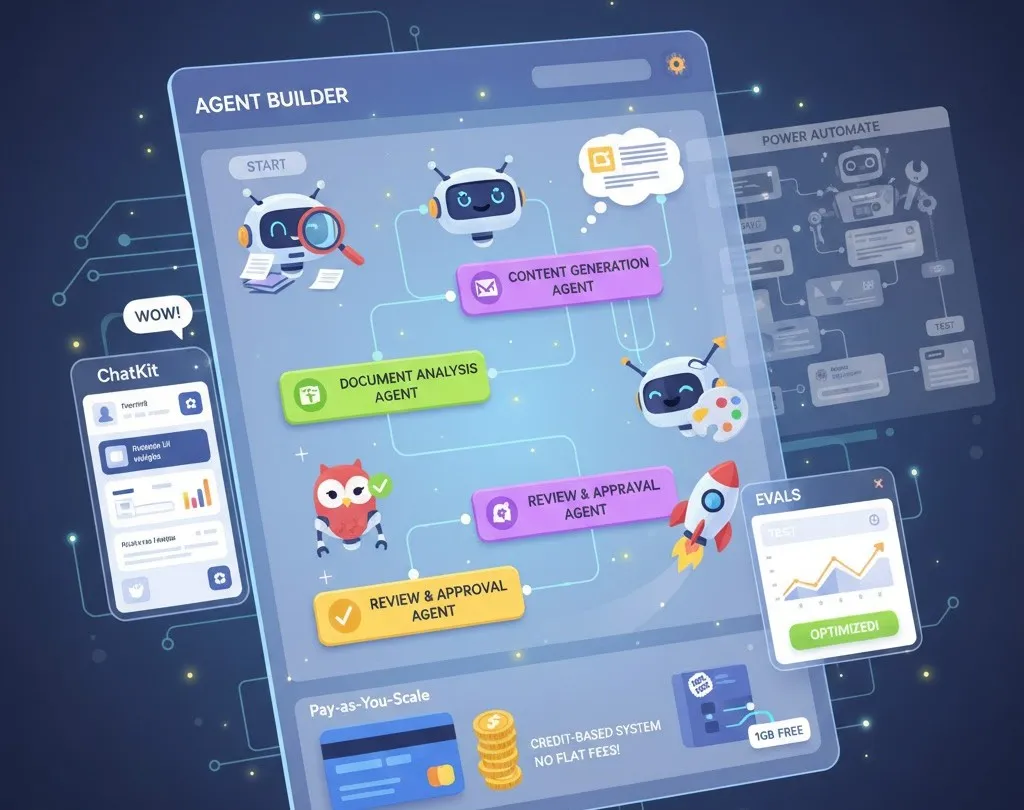
OpenAI's AgentKit is a new suite of tools that makes building, deploying, and optimizing AI agents much easier. It unifies fragmented workflows, no more juggling orchestration code, eval pipelines, and manual connectors. Instead, AgentKit provides building blocks that work together:
Agent Builder: A visual canvas for designing and running multi-agent workflows
Connector Registry: Centralized hub for managing connectors across products, enabling enterprise control and governance
ChatKit: Embeddable, customizable chat UIs for agent interactions
Evals: Tools for datasets, grading, and prompt optimization, delivering measurable performance gains
This ecosystem runs inside the OpenAI platform, making it accessible to anyone already using an OpenAI developer account.
AgentKit follows OpenAI's standard usage-based pricing. Instead of flat SaaS fees, costs scale directly with consumption:
No flat fees: Pay only for compute, tokens, and data usage
Credit-based system: Credits start at $5, with optional auto-recharge to prevent interruptions
Automatic recharge: Configure thresholds to avoid interruptions
Vector storage: Includes 1GB free capacity, then $0.10/GB/day beyond that
This credit-based flexibility ensures businesses only pay for what they use while retaining the ability to scale.
ChatKit makes embedding AI-powered chat interfaces simple. Instead of weeks of frontend work, developers can add:
Real-time, streaming model responses
Rich, interactive widgets (forms, media, data visualizations)
Branded, theme-matched chat experiences
Early adopters like Canva and HubSpot report deploying support agents in hours, not weeks, transforming how users engage with their systems.
Agent Builder includes first-class support for vector embeddings and Retrieval-Augmented Generation (RAG):
Upload and manage organizational documents
Build hybrid search (semantic + keyword)
Keep knowledge bases updated automatically
With 1GB of included storage, smaller teams can experiment at no cost, while enterprises can expand beyond that at $0.10/GB per day.
The most transformative feature is multi-agent orchestration. Teams can design workflows where different agents specialize:
Analysis Agent → Processes and extracts info from documents
Content Generation Agent → Produces articles, reports, or marketing assets
Image Agent → Generates visuals
Approval Agent → Handles human review steps
Publishing Agent → Distributes to CMS or platforms
This mirrors human teamwork and enables sophisticated automation.
Sign up via platform.openai.com/agent-builder
Load credits (e.g., $10 to start testing)
Experiment with templates or build from scratch
AgentKit could potentially complement tools like:
Make.com → complex integrations
Power Automate → Microsoft ecosystem workflows
Webflow → publishing content
Teams → approval & notifications
Start without auto-recharge enabled
Monitor early usage closely
Regularly review vector storage consumption
AgentKit introduces AI-native automation, not just connecting services but making workflows intelligent. Compared to traditional tools, it offers:
Smarter decision-making
Handling of unstructured data
Built-in evals for reliability
Multi-agent orchestration
This positions OpenAI as a direct competitor to enterprise automation platforms, but with deeper intelligence baked in.
AgentKit signals a shift toward intelligent automation. We can expect:
Better reasoning and memory in workflows
Seamless collaboration between AI agents and humans
Richer natural language interfaces for business users
Faster iteration cycles with built-in evals and versioning
For businesses, AgentKit isn't just another automation tool, it's a practical, scalable path to embedding advanced AI into daily operations.
The future of automation is not just about tasks being automated, but about agents reasoning, collaborating, and adapting in real-time. OpenAI's AgentKit is the toolkit that makes this vision achievable.
Effective AI prompting requires constraining the problem, permissions, and success criteria, not the intelligence. Learn how to empower your AI agents.
Aug 1, 2026 · 4 min read
Read moreStop copy-pasting standard code snippets. Learn how AI coding agents use system context to automate workflows, fix bugs, and build better software.
Jul 30, 2026 · 5 min read
Read moreA case study on why fixed UI is becoming less important and how runtime-rendered interfaces can revolutionize operational software and business workflows.
Jul 30, 2026 · 7 min read
Read moreWe build the systems described here. A short call is usually enough to tell whether it's worth building.