
FlowDevs
Constrain the Problem, Not the Intelligence
Effective AI prompting requires constraining the problem, permissions, and success criteria, not the intelligence. Learn how to empower your AI agents.
Aug 1, 2026 · 4 min read
Read more
November 14, 2025 · 4 min read · Justin Trantham
Google's quietly released Gemini 3 and its Canvas feature may mark a major shift in AI-powered app development. Explore how conversational, mobile-first tools could disrupt no-code platforms and redefine the future of software creation.
The AI development landscape may have just experienced a seismic shift that few noticed. Google appears to have silently released Gemini 3, introducing a revolutionary Canvas feature that transforms mobile devices into powerful development environments. This isn't just another incremental update, it's potentially a paradigm shift that threatens to disrupt the entire no-code and low-code development ecosystem.
The new Canvas functionality represents a fundamental breakthrough in accessibility and ease of development. Users can now create fully functional applications directly on their mobile devices without requiring additional software or platforms. The process is remarkably streamlined:
Select the Canvas feature within the Gemini app
Input simple prompts describing your desired application
Iterate and debug in real-time through conversational commands
Deploy functional apps without traditional coding knowledge
This immediate, conversational approach to app development eliminates traditional barriers that have historically separated ideas from implementation.
The implications for established development platforms are staggering. Services like Lovableand Replit, which have built their business models around simplified coding experiences, now face an existential threat. The value proposition becomes increasingly difficult to justify when:
Gemini subscriptions potentially include comprehensive development capabilities
New Pixel phone purchases bundle these features
The user experience appears superior on mobile devices
Real-time debugging happens through natural language interaction
This shift raises fundamental questions about the sustainability of paid coding platforms when tech giants can integrate similar, or superior, functionality into their existing ecosystems.
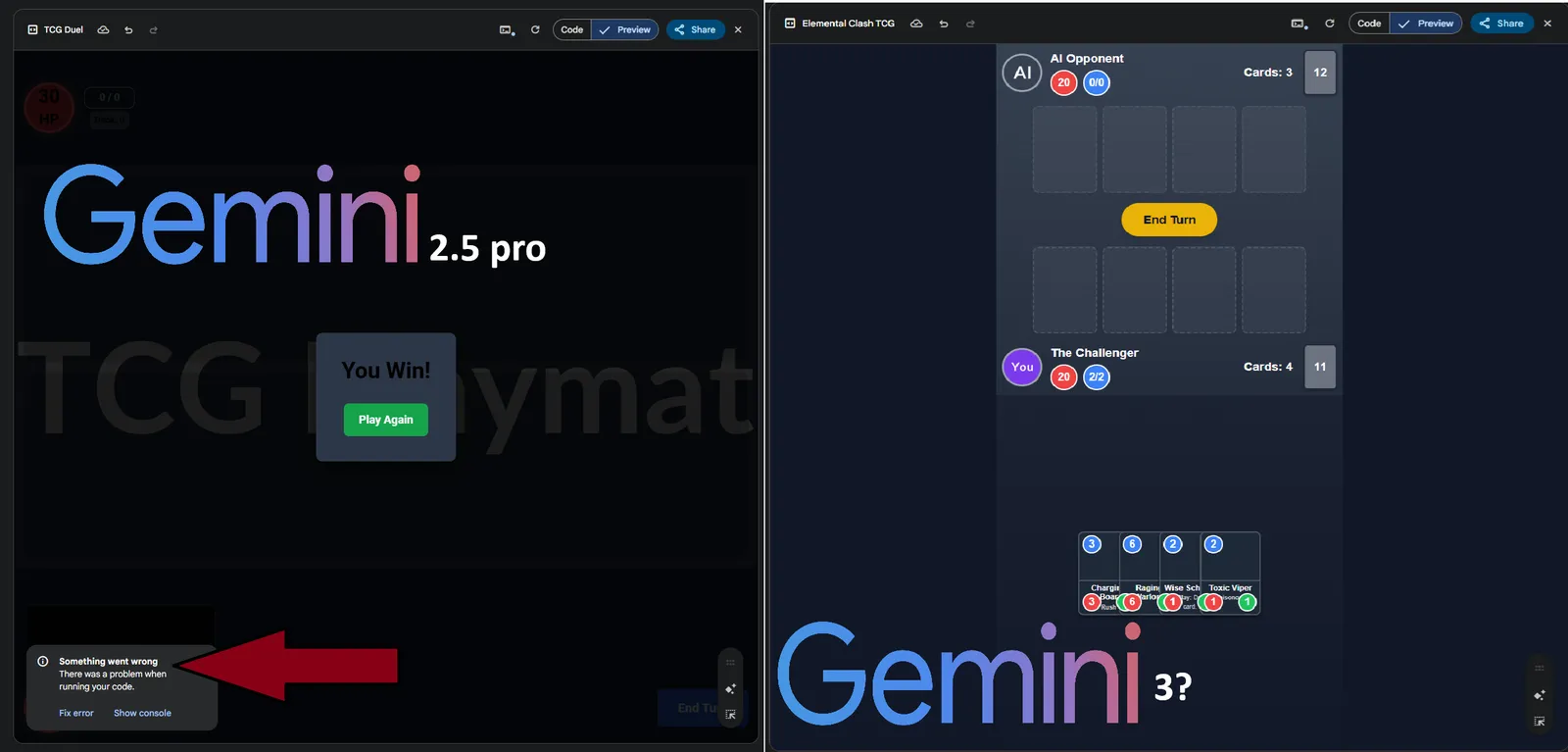
Testing reveals a surprising performance disparity between mobile and web implementations. In practical demonstrations involving Trading Card Game (TCG) development:
Mobile Canvas Performance:
Single prompt generated playable applications
Quick layout adjustments for mobile optimization
Successful feature integration (Taunt, Haste mechanics)
Responsive debugging and iteration
Web-Based Gemini 2.5 Pro Performance:
Multiple prompts failed to produce functional games
Basic gameplay mechanics remained broken after extensive iteration
Layout issues persisted across testing sessions
Fundamental loading problems went unresolved
This performance gap suggests either the deployment of Gemini 3 on mobile platforms or significant optimization differences between mobile and web implementations.
The broader strategic implications extend far beyond individual app development:
For Businesses:
Reduced dependency on specialized development teams
Accelerated prototyping and MVP creation
Lower barriers to digital transformation initiatives
Potential cost savings on development tools and platforms
For Individual Creators:
Democratized access to app development
Immediate idea-to-implementation workflows
Reduced learning curves for non-technical users
Mobile-first development optimization
This development signals Google's aggressive push into the application development space, leveraging their AI capabilities to create vertical integration opportunities. The strategy effectively:
Captures users within the Google ecosystem
Reduces reliance on third-party development platforms
Creates new revenue streams through enhanced subscription offerings
Establishes mobile devices as primary development environments
The silent nature of this release suggests Google's confidence in the technology and their strategic approach to market disruption. As the technology matures, we can expect:
Increased pressure on traditional no-code platforms to differentiate
Potential consolidation within the simplified development space
Enhanced mobile development capabilities across competing platforms
Greater emphasis on AI-driven development workflows
The fundamental question facing the development community isn't whether AI will transform coding practices, but how quickly traditional platforms can adapt to remain relevant in an increasingly AI-native development landscape.
Whether this represents the official launch of Gemini 3 or advanced testing of enhanced capabilities, the implications are clear: we're witnessing the emergence of truly accessible, AI-powered development tools that could fundamentally reshape how applications are conceived, created, and deployed.
The superior mobile performance, combined with the seamless integration into existing Google services, positions this technology as a potential industry standard. For developers, businesses, and creative professionals, the message is unmistakable, the future of development is conversational, mobile-first, and increasingly democratized.
The only remaining question is whether competing platforms can innovate quickly enough to maintain relevance in this rapidly evolving landscape, or if Google's integrated approach will dominate the accessible development market entirely.
Effective AI prompting requires constraining the problem, permissions, and success criteria, not the intelligence. Learn how to empower your AI agents.
Aug 1, 2026 · 4 min read
Read moreStop copy-pasting standard code snippets. Learn how AI coding agents use system context to automate workflows, fix bugs, and build better software.
Jul 30, 2026 · 5 min read
Read moreA case study on why fixed UI is becoming less important and how runtime-rendered interfaces can revolutionize operational software and business workflows.
Jul 30, 2026 · 7 min read
Read moreWe build the systems described here. A short call is usually enough to tell whether it's worth building.