
FlowDevs
Constrain the Problem, Not the Intelligence
Effective AI prompting requires constraining the problem, permissions, and success criteria, not the intelligence. Learn how to empower your AI agents.
Aug 1, 2026 · 4 min read
Read more
April 27, 2026 · 5 min read · Justin Trantham
GitHub Copilot Pro is moving to usage-based billing on June 1st. Learn how AI credits, token consumption, and GitHub Actions impact your AI coding workflow.
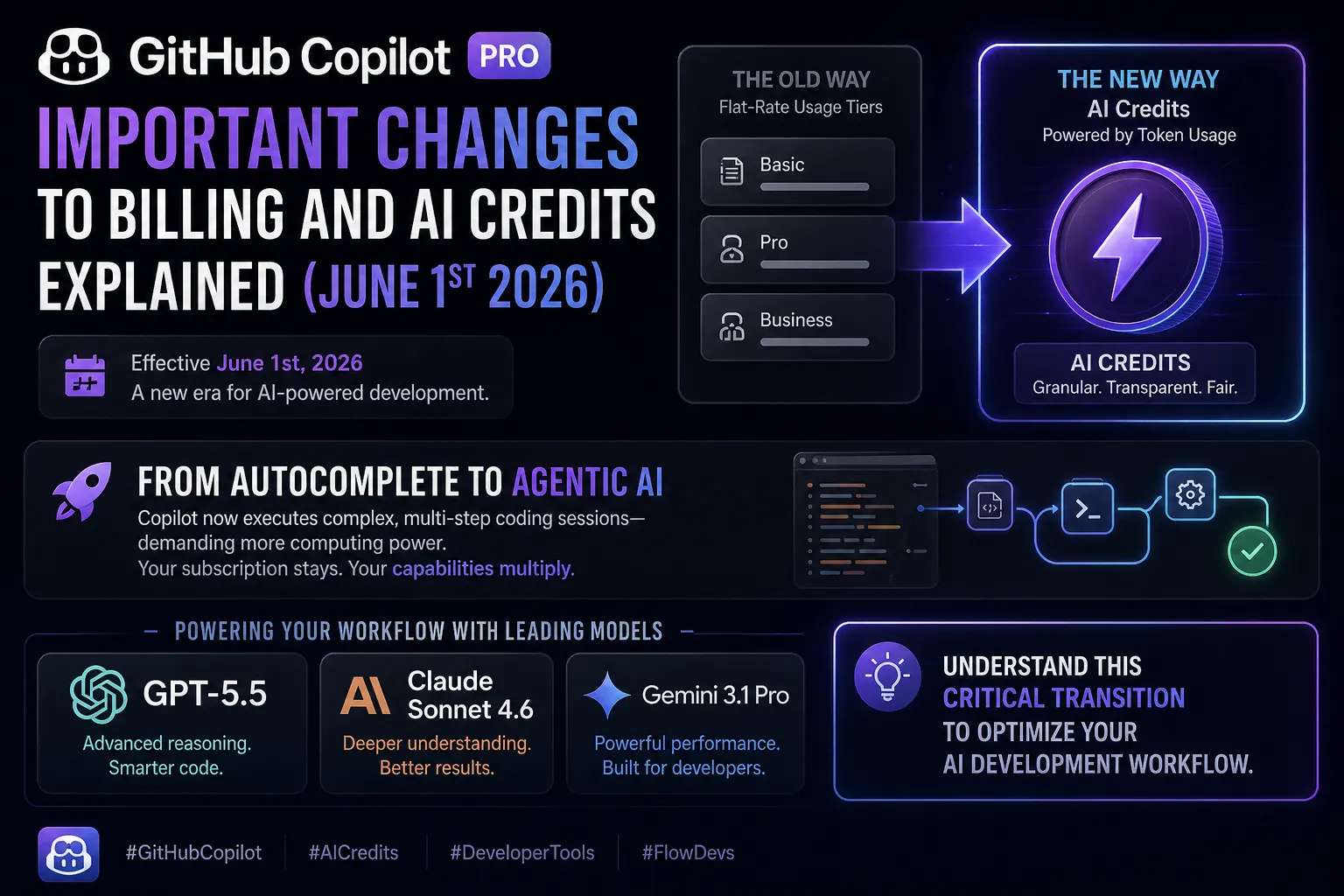
GitHub is fundamentally changing how it charges for its AI coding assistant starting June 1st. If you use the Copilot Pro or Pro+ tier, your account is shifting from a flat usage model to usage-based billing powered by new AI Credits. This change reflects a massive evolution in artificial intelligence. Copilot is no longer just a simple autocomplete tool that sits quietly in your editor. It has grown into an agentic platform capable of executing long, multi-step coding sessions across entire repositories. Because these complex tasks require significantly more computing power, GitHub is overhauling its pricing structure to make the robust service sustainable for everyone.
To understand the billing changes, we have to look at how software development is shifting. Over the last year, artificial intelligence has moved from single-query answers to true agentic behaviors. This means the AI can plan, iterate, and execute complex workflows on its own. While this makes building applications incredibly fast, it drastically increases the compute and inference demands on backend servers. To keep up with the massive data requirements of modern code generation, GitHub is moving the platform to a usage-based billing model. It is important to note that basic code completions and next edit suggestions will remain included in all plans without eating into your new token limits.
On June 1st, Premium Request Units (PRUs) will be completely replaced by GitHub AI Credits. Instead of tracking abstract usage tiers, these new credits represent a monthly allotment tied directly to raw token consumption. This aligns your costs with actual AI model usage.
Your AI Credits will be consumed by three main metric areas:
Input tokens, representing your prompts and code context.
Output tokens, representing the code generated by the AI model.
Cached tokens, used to speed up repetitive requests and context loading.
Here is the good news for developers. Your base subscription pricing remains exactly the same. The standard Copilot Pro plan still costs $10 per month, and the Pro+ plan remains $39 per month. However, under the new model, those subscription fees grant you exactly $10 and $39 in monthly AI Credits, respectively, to use on advanced agentic features. Once you deplete your monthly AI Credits, you will either need to wait for your billing cycle to reset, purchase additional usage, or upgrade your plan. The previous fallback experiences are being officially retired.
One of the biggest technical shifts in this GitHub Copilot update involves automated code reviews. Copilot code review utilizes a highly complex agentic architecture to deeply understand your pull requests. To support this level of automation, the feature now runs directly on GitHub Actions.
Because of this structural change, running an AI code review will now consume your regular GitHub Actions minutes in addition to your AI Credits. These execution minutes will be billed at the standard per-minute rates you already use for your CI/CD pipelines. This makes it crucial to monitor both your LLM token usage and your pipeline execution times.
GitHub is offering a solid grace period to help developers and teams adapt. In early May, they are launching a new billing preview dashboard. This internal tool will allow you to calculate exactly what your April usage would have cost under the new billing model. We recommend checking this dashboard early so you can adjust your coding habits before the rules officially change.
No. Standard code completions and next edit suggestions are firmly included in all plans and do not consume your AI credit allotment.
Advanced AI features will pause. You will need to wait for your monthly reset, buy extra credits, or upgrade your plan. The old fallback experiences are being removed entirely.
The flat monthly cost remains unchanged at $10 for Copilot Pro and $39 for Pro+, but you now have a hard cap on heavy agentic tasks based directly on that dollar value.
The new billing structure, including token consumption tracking and Actions minute routing, officially takes effect on June 1st.
As artificial intelligence becomes deeply embedded in our daily developer workflows, managing the underlying compute costs and infrastructure is more critical than ever. The transition to usage-based billing for developer tools is just one piece of a much larger industry shift toward intelligent automation and highly agentic systems.
At FlowDevs, we build the integrated digital systems that power modern business. We specialize in unlocking efficiency and innovation by developing custom web applications, building scalable cloud infrastructure, and providing end-to-end digital strategy.
Our core focus is on AI and intelligent automation. We are consultants for Power Apps, Power Automate, and Copilot Studio, dedicated to streamlining your complex workflows and creating intelligent solutions that drive real-world results. From process integration to custom app development, we partner with you to bring your technical vision to life. If you are ready to optimize your digital strategy, schedule a consultation on our bookings page at https://bookings.flowdevs.io so we can start building together.
Check out this post on Techne Blog.
Effective AI prompting requires constraining the problem, permissions, and success criteria, not the intelligence. Learn how to empower your AI agents.
Aug 1, 2026 · 4 min read
Read moreStop copy-pasting standard code snippets. Learn how AI coding agents use system context to automate workflows, fix bugs, and build better software.
Jul 30, 2026 · 5 min read
Read moreA case study on why fixed UI is becoming less important and how runtime-rendered interfaces can revolutionize operational software and business workflows.
Jul 30, 2026 · 7 min read
Read moreWe build the systems described here. A short call is usually enough to tell whether it's worth building.