
FlowDevs
Constrain the Problem, Not the Intelligence
Effective AI prompting requires constraining the problem, permissions, and success criteria, not the intelligence. Learn how to empower your AI agents.
Aug 1, 2026 · 4 min read
Read more
February 19, 2026 · 4 min read · Justin Trantham
Gemini 3.1 Pro offers advanced reasoning and 77.1% verified scores on ARC-AGI-2. Discover how this Google AI upgrade powers complex business automation.
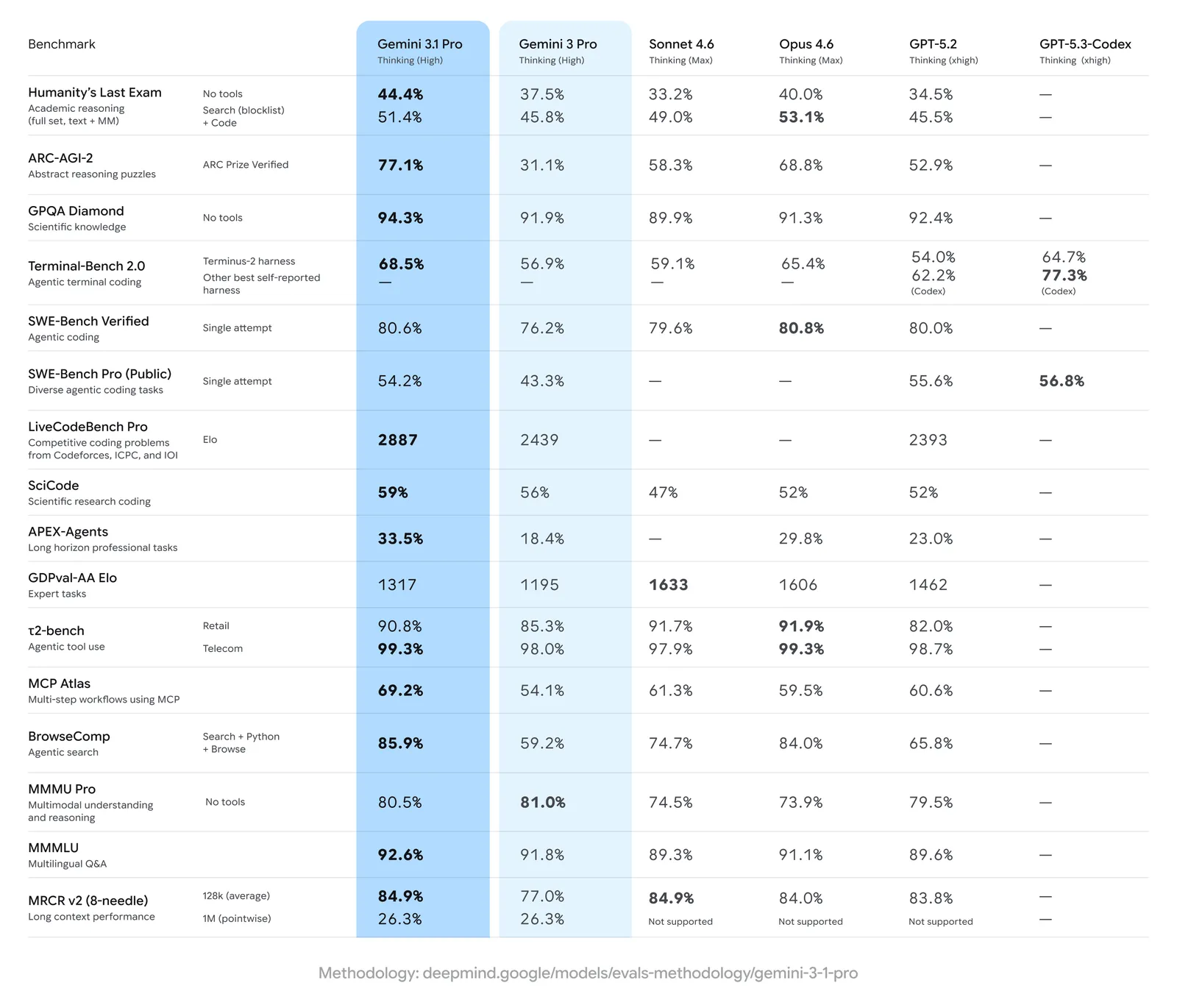
Gemini 3.1 Pro has arrived, establishing a new baseline for core intelligence by achieving a verified score of 77.1% on the rigorous ARC-AGI-2 benchmark, more than doubling the reasoning capabilities of its predecessor. This release signals a shift away from AI that simply retrieves answers toward systems that can handle intricate workflows, visualize complex topics, and organize scattered data into coherent strategies. For businesses and developers, this means the tools we use to drive efficiency are now capable of solving novel logic patterns they have never encountered before.
In the world of machine learning, an upgrade is usually measured by speed or context window size. However, the release of Gemini 3.1 Pro focuses entirely on advanced reasoning. The ARC-AGI-2 benchmark is significant because it tests for "general intelligence" rather than just memorization. It presents the model with logic puzzles that require abstraction and generalization.
When Google AI notes that 3.1 Pro scored 77.1% compared to the previous version's lower performance, it implies a massive jump in the model's ability to "think" through a problem rather than just predicting the next likely word. This type of deep cognitive processing is exactly what is required when we move from simple chatbots to intelligent automation systems that manage business-critical operations.
At FlowDevs, we speak often about "unlocking efficiency," and this new iteration of Google AI provides the key for much tougher locks. The 3.1 Pro architecture is designed for scenarios where a simple answer is insufficient. It excels in three specific areas that align closely with enterprise needs:
Visual Explanations: It can break down dense technical concepts into clear, visual explanations, bridging the gap between engineering teams and stakeholders.
Data Synthesis: The model can ingest scattered data points from various documents and synthesize them into a single, comprehensive view.
Project Realization: It aids in bringing creative and technical projects to life by maintaining context over long, multi-step execution plans.
Whether we are building scalable cloud infrastructure or configuring Copilot Studio, having an underlying model that understands nuance allows us to build reliable, hands-off workflows.
Google is rolling this out aggressively across its ecosystem. This broad availability allows us to integrate this upgraded intelligence into various layers of your digital strategy immediately.
Developers access 3.1 Pro in preview via the API in Google AI Studio and the Gemini CLI. Notably, it is also available in Google Antigravity, the new agentic development platform. This is crucial for custom app development, allowing engineers to embed high-level reasoning directly into the backend of proprietary software.
On the business side, the model is shipping to Vertex AI and Gemini Enterprise. For heavy power users utilizing NotebookLM, a favorite for research and synthesis, this update is available exclusively to Pro and Ultra users. This ensures that the systems generally used for data-heavy lifting are now backed by the strongest logic engine available.
What is the main difference between Gemini 3 Pro and 3.1 Pro?
The primary difference lies in reasoning capabilities. 3.1 Pro more than doubles the score of 3 Pro on the ARC-AGI-2 benchmark, making it significantly better at solving novel logic puzzles and handling complex, multi-step tasks.
Where can I access Gemini 3.1 Pro right now?
It is rolling out in the Gemini app, NotebookLM (for Pro/Ultra users), Google AI Studio, Vertex AI for enterprise, and Android Studio for mobile developers.
Why is "reasoning" important for business automation?
Standard AI is good at following recognized patterns. "Reasoning" allows the AI to handle exceptions and edge cases in your workflows without breaking, making intelligent automation much more reliable.
Does this integrate with custom applications?
Yes. Through the API and platforms like Vertex AI, teams can build custom web applications that utilize 3.1 Pro as the reasoning engine behind the specific business logic.
The arrival of Gemini 3.1 Pro is exciting, but advanced AI is only as good as the system it powers. A high-reasoning model needs to be connected to your data sources, wrapped in secure cloud infrastructure, and directed by a clear digital strategy to generate ROI.
At FlowDevs, we specialize in taking these cutting-edge technologies, from Google's latest models to Power Automate and Copilot Studio, and forging them into cohesive systems that drive real-world results. If you are ready to streamline your complex workflows using the latest in intelligent automation, we are ready to build the infrastructure to support it.
Let's discuss how to apply advanced reasoning to your business challenges. Book a consultation with us at bookings.flowdevs.io.
Check out this post on Techne Blog.
Effective AI prompting requires constraining the problem, permissions, and success criteria, not the intelligence. Learn how to empower your AI agents.
Aug 1, 2026 · 4 min read
Read moreStop copy-pasting standard code snippets. Learn how AI coding agents use system context to automate workflows, fix bugs, and build better software.
Jul 30, 2026 · 5 min read
Read moreA case study on why fixed UI is becoming less important and how runtime-rendered interfaces can revolutionize operational software and business workflows.
Jul 30, 2026 · 7 min read
Read moreWe build the systems described here. A short call is usually enough to tell whether it's worth building.