
FlowDevs
Constrain the Problem, Not the Intelligence
Effective AI prompting requires constraining the problem, permissions, and success criteria, not the intelligence. Learn how to empower your AI agents.
Aug 1, 2026 · 4 min read
Read more
December 17, 2025 · 5 min read · Justin Trantham
Move from 'vibe coding' prototypes to scalable enterprise solutions. Discover the 3 personas of AI creatives and why infrastructure is key to success.
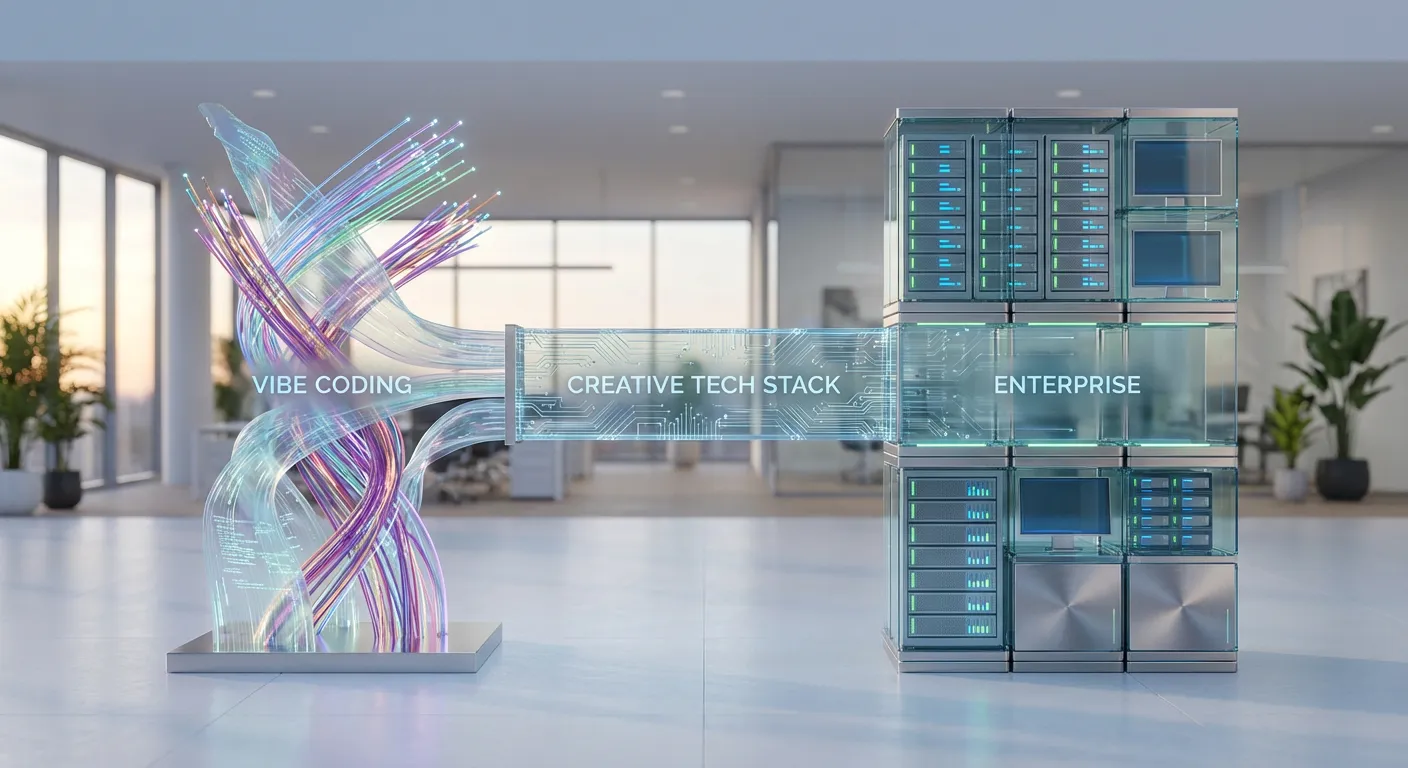
We are witnessing a fundamental shift in how creative work gets done. It is no longer just about having an innovative idea; it is about drastically reducing the gap between your curiosity and the execution of that curiosity. We call this the era of "Vibe Coding", where the barrier to entry for building complex applications, videos, and brand assets has collapsed. However, moving from a fun prototype to a scalable enterprise solution requires more than just a clever prompt.
In recent demonstrations of next-generation AI workflows, we have seen how global brand presence can be built in minutes using a suite of AI tools. But the secret isn't the tool itself; it is the workflow. To replicate this success in a business context, you must treat the technology as a comprehensive stack rather than a novelty.
The most common mistake businesses make is treating AI as a vending machine, insert a coin, get content. The real power unlocks when you utilize the model as a collaborator. This involves a conversational workflow. Instead of simply typing a prompt, you converse with the model. We have seen success in feeding "jumbo" concepts to models and asking them to establish color palettes, tones, and visual guidelines. This allows the AI to write the technical prompts for other tools, effectively bridging the gap between human intent and machine execution.
For a long time, the holy grail of generative AI was consistency. In an enterprise setting, you cannot have your brand mascot morphing into a different species halfway through an advertisement. The solution lies in reference-based generation and establishing a visual source of truth. By defining a brand guideline and a character asset first, we can use image-to-video workflows to animate specific assets. This ensures that the "actor" in your digital content remains consistent across all media.
Perhaps the most exciting development is that everyone is now a builder. You do not need to be a senior developer to create particle animations or complex web interactions. We are seeing workflows where strategists ask AI to write code that animates particles into specific shapes. Tasks that once took hours of manual coding now take minutes. At FlowDevs, we see this as the ultimate unlock for efficiency, allowing us to focus on high-level architecture while intelligent automation handles the implementation details.
The market is flooded with AI creative tools, yet many fail to gain traction in the enterprise. This is often because developers treat all users as a single "creative" type. If you are building custom applications or internal tools, you must segment your audience.
The Creative Builder: This user is technical and desires programmability. They want to wire up nodes and build complex pipelines. A simple text box is insufficient for them; they need granularity and control.
The Creative Professional: These are designers who have lived in professional software for decades. They care about lighting, composition, and specific camera angles. The UX must expose these controls rather than hiding them.
The AI-Native Operator: This is a massive new segment including founders and marketing operations leaders. They may not know about "hero's journeys," but they know business results. The "Empty Box Trap", giving these users a blank text box, sets them up for failure. Effective interfaces guide them through the process step-by-step.
Spinning up a virtual try-on app or a fun generator on a lunch break is one thing. Scaling that app to an enterprise level is entirely different. This is where FlowDevs steps in to bridge the gap between a hobbyist prototype and robust business infrastructure.
If you are building an app for internal teams or customers, speed is a feature. Creatives and operators need to remain in a "flow state." If they have to wait 60 seconds for an image because you are sharing a compute pool with the rest of the world, that flow is broken. Enterprise solutions require provisioned throughput, reserved capacity that guarantees speed regardless of network traffic.
We are moving into a world where data provenance allows for trust. If you are building for enterprise clients, they need to verify what was AI-generated. Implementing technologies like watermarking and tracking is essential for auditing and legal compliance. You cannot easily retrofit this security; it must be part of your scalable cloud infrastructure from day one.
Finally, the best way to determine what to build next is to look at your logs. When specific prompts or manual requests appear repeatedly, that is a signal to automate. We help clients turn these data signals into UI features, tightening the loop between user intent and execution.
Whether you are looking to integrate intelligent automation into your current workflows or build a custom web application from the ground up, the advice is the same: Just get started. The tools are powerful enough to build a brand or an application in record time, but the infrastructure requires expertise to scale.
At FlowDevs, we partner with you to bring your technical vision to life, ensuring your move from "vibe coding" to enterprise deployment is seamless, secure, and impactful. If you are ready to modernize your creative tech stack, let's talk.
Effective AI prompting requires constraining the problem, permissions, and success criteria, not the intelligence. Learn how to empower your AI agents.
Aug 1, 2026 · 4 min read
Read moreStop copy-pasting standard code snippets. Learn how AI coding agents use system context to automate workflows, fix bugs, and build better software.
Jul 30, 2026 · 5 min read
Read moreA case study on why fixed UI is becoming less important and how runtime-rendered interfaces can revolutionize operational software and business workflows.
Jul 30, 2026 · 7 min read
Read moreWe build the systems described here. A short call is usually enough to tell whether it's worth building.