
FlowDevs
Constrain the Problem, Not the Intelligence
Effective AI prompting requires constraining the problem, permissions, and success criteria, not the intelligence. Learn how to empower your AI agents.
Aug 1, 2026 · 4 min read
Read more
October 23, 2025 · 9 min read · Justin Trantham
Turn AI prototypes into production: hybrid multimodal RAG, structured RAG, agent/workflow design, Azure AI tuning, MCP tooling, and evaluation best practices.
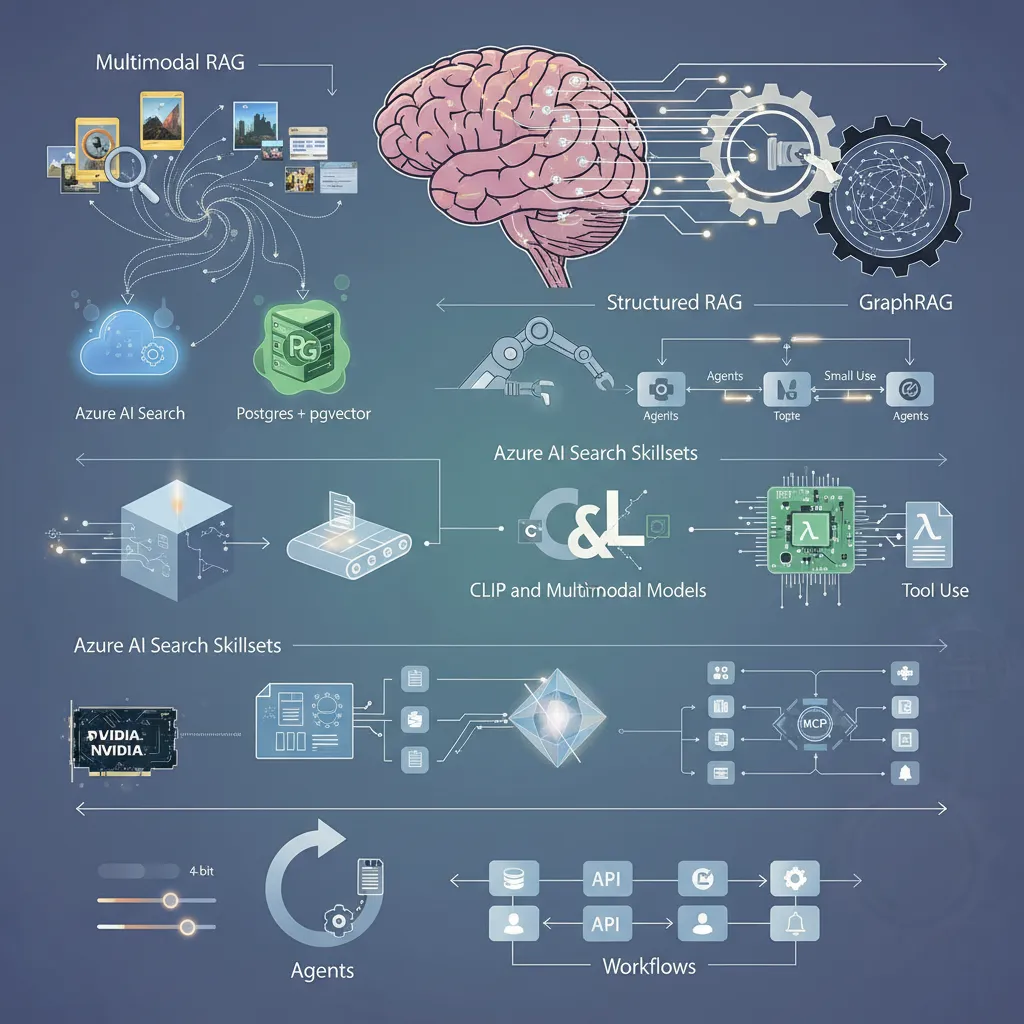
Automation teams need reliable ways to turn prototypes into production. Across multimodal retrieval, structured RAG, agent orchestration, and Azure AI choices, a few disciplined patterns consistently drive speed, relevance, and maintainability. Here's a set of thought-leadership summaries designed to improve discoverability and SEO for FlowDevs.io and automation-focused companies.
Multimodal retrieval doesn't need to be complex to deliver value. Treat images and text as first-class citizens connected by vectors, then layer hybrid search for robustness.
Key principles:
Start simple: Generate a single embedding per image. Validate similarity with sniff tests (e.g., a Pokémon card should match other card-like images).
Cross-modal search: Compare image vectors to text embeddings; unlock queries like "card," "trading," or "holo" for text-to-image search and image-to-text tagging.
Storage is a product choice:
Azure AI Search: Hybrid vector + keyword, built-in skillsets, scalable ingestion.
Postgres + pgvector: Portable, flexible, aligns with existing ops.
What to build now:
Text-to-image lookup ("Find all cards featuring electric type").
Image deduplication and near-duplicate detection.
"More like this" related images.
Semantic tagging at ingest to enrich metadata.
Pro tip:
Bottom line:
GraphRAG is compelling but often costly and slow for dynamic corpora. Structured RAG wins early by extracting lightweight entities, actions, and topics at ingest.
What works in practice:
GraphRAG promise: Global reasoning across a corpus for multi-hop answers.
Reality: High token costs, long ingestion, poor fit for incremental updates.
Structured RAG: Process each message/document independently with a cheaper pass; retrieve "knowledge nuggets" plus original text for explainability.
Recommendations:
Stable, fixed corpus with broad reasoning needs: Pilot GraphRAG with strict cost guardrails.
Living systems (support logs, forums, transcripts, product notes): Choose Structured RAG for maintainability and cost awareness.
Agent frameworks promise orchestration and memory, but smaller models can struggle under hidden complexity.
Observed patterns:
Larger models perform more reliably in popular agent frameworks; smaller models falter when prompts are verbose, planning is deep, or APIs differ.
Tool calling nuances matter:
Some models work best with "responses" style function-calling.
Framework API mismatches cause silent failures or hallucinations.
OpenAI's Agents SDK often aligns cleanly with its responses API.
Other frameworks may need patches/config tweaks; some teams revert to simpler SDKs when small models misbehave.
Action plan:
If committed to small models, validate end-to-end with your exact framework/tools early.
Keep chains shallow, prompts minimal, and cap conversation history aggressively.
File reproducible traces upstream to improve ecosystem compatibility.
When to use agents:
Strong fit: Deterministic tool use with strict input/output schemas and bounded context.
Avoid: Long multi-tool planning loops with small models unless the task is tightly constrained and thoroughly tested.
Skillsets accelerate document cracking and enrichment, but custom skills deliver precision.
Guidance:
Prefer Document Intelligence over legacy OCR for robustness.
Ideal for standard PDFs, forms, common layouts.
Azure Functions as custom skills for exact extraction.
Control chunking, metadata normalization, domain vocabularies to improve retrieval quality.
Combine vector similarity with keyword filters and metadata for relevance and repeatability.
Principle:
CLIP-style encoders align images and text in a shared space, enabling straightforward cross-modal search.
What matters:
Treat the image encoder as the bridge to language. Evaluate on your domain and keep an abstraction layer to swap encoders if relevance drifts.
Many multimodal models share architectural ideas (vision encoder feeding an LLM), but implementations vary across providers.
Tests to run:
In-domain retrieval: Does text reliably find the right images and vice versa?
Robustness: Lighting, crops, watermarks, orientation.
Cold start: Minimal prompt knowledge for niche taxonomies.
Avoid complexity creep by separating agents from workflows.
Definitions:
Agents: LLMs that call tools in a loop for targeted tasks.
Workflows: Composed sequences where some steps use agents and others use APIs, DB queries, or human approvals.
Patterns:
Use a single agent for constrained tasks with well-defined tools (e.g., enrichment).
Use workflows for multi-step processes: agent calls, approvals, retries, audits, notifications.
Scale with graphs: Engines like LangGraph where nodes are agent calls, human reviews, or external APIs.
Why it matters:
Performance and cost: Workflows place boundaries, cache results, and enforce timeouts.
Observability: Step-level instrumentation is simpler; attach evaluations where they add value.
Avoid duplicating tool schemas by leveraging MCP (Model Context Protocol).
How to apply:
Prefer MCP-compatible servers so agents can discover and call tools with standardized definitions.
For local functions, use decorators or signatures the framework can auto-convert to tool schemas.
Build a catalog: Registry of MCP servers and local tools with versioning, access control, and observability, your internal marketplace for reusable capabilities.
Practical guidance:
Works cleanly without tool calling out of the box.
Tool calling may require a workaround depending on versions, check repo examples and package docs.
Start minimal (no tools), add definitions incrementally, and validate round-trip structured calls.
Tips:
Keep tool contracts stable; schema mismatches trigger retries and latency.
Separate model management (Foundry Local) from orchestration (Agent Framework).
Quantization enables local deployment on commodity GPUs.
Pragmatic choices:
4-bit can be usable for small/medium models.
8-bit is safer for accuracy-sensitive workloads.
Best practices:
Benchmark with real prompts and tools; synthetic tests aren't enough.
Measure end-to-end latency; tool/retrieval time often dominates UX.
If tool calls dominate, quantization differences may be immaterial to overall latency.
Use evaluators like Azure's groundedness judiciously.
Approach:
Offline evaluation: Ideal for model upgrades, prompt changes, regression checks.
Online evaluation: Adds latency; use when accuracy is critical and signals gate user output.
Lessons:
Reflection loops (generate → evaluate → reflect → re-answer) often don't improve most answers and harm UX.
Lightweight alternative: Ask for a confidence score or brief self-check in the main generation step; use it for UI or routing without extra calls.
Operationally: Run online evaluation for analytics rather than gating, unless the domain demands it.
Institutionalize comparative testing.
Practices:
Implement the same task across multiple models and frameworks to surface edge cases and tool schema pitfalls.
Maintain compatibility layers to swap models/frameworks without touching business logic.
Track comparative metrics: accuracy, latency, tool success rate, token use, error modes; drive model selection and prompt updates.
Reliable local stacks win with boring, portable primitives.
Guidance:
Documents: local vector DBs (e.g., Chroma) or SQLite with vector support (e.g., LibSQL).
Structured/tabular: Postgres + pgvector + full-text search.
Keep stacks open: Pure Python packages and standard DBs age better offline.
Model selection:
Evaluate embeddings (e.g., strong public leaderboard performers) for your domain/language before standardizing.
Pro tip:
Trade-offs:
Hand-rolled: More glue code to validate calls, schemas, and malformed arguments, greater portability, higher complexity.
Frameworks: Encapsulate function-calling semantics, error handling, and orchestration so you can focus on product value.
Rule of thumb:
Clarity accelerates adoption:
Use Draw.io for architecture diagrams and animated connectors when motion helps explain flow.
Communicate complexity simply; animated diagrams compress minutes of explanation into seconds of understanding.
Realities:
Global Standard SKU: Best-effort latency, acceptable for many UX, but can spike.
Provisioned Throughput: Predictable performance with PTUs, suited for customers needing consistency.
Batch: Non-interactive, high-volume jobs, great for backfills and evaluations.
Optimization playbook:
Choose regions close to execution environment; avoid cross-region hops.
Scale capacity/concurrency; test smaller, faster models when accuracy permits.
Benchmark rigorously: token throughput, first-token latency, total latency under load.
Advice:
Match learning modality to preference (videos, live streams, interactive exercises).
Build projects early; disable coding agents temporarily to master fundamentals.
Use modern Python 3.x resources and browser-based exercises for rapid iteration.
Mindset:
Blend UX with cognitive science:
Implement spaced repetition (Leitner/Anki).
Use embeddings + RAG for contextual explanations; keep outputs short and actionable.
Prototype flashcard UX quickly (browser-first); add a Python backend for generation, tagging, and graphs.
Cite evidence and neuroscience; keep explanations scannable.
LinkChain announcement at 9 a.m
Agents stream at 10 a.m
November: Benchmarking model performance, latency, throughput, and UX impact
Multimodal RAG pipelines: Image/text retrieval with hybrid ranking on Azure AI Search or pgvector.
Structured RAG ingestion: Entity/action extraction for incremental scalability.
Agent tool-use hardening: Minimal orchestration, schema-first function calling, eval-driven constraints for small-model reliability.
Custom skillsets: Azure Functions for high-fidelity document cracking and domain-tailored enrichment.
Relevance engineering: Dataset curation, embedding selection, hybrid weighting, regression tests to sustain search quality.
Agent framework engineering: MCP-based tool catalogs, error-resilient orchestration, and observability-first workflows.
Evaluation pipelines: Offline suites and lightweight online signals to tune models without hurting UX.
Local optimization: Quantization benchmarks and hardware-aware tuning for performance per dollar.
Automation excellence is about disciplined choices:
Separate agents from workflows; constrain loops and tools.
Use MCP to avoid schema duplication and accelerate integration.
Prefer offline evaluation; apply online signals sparingly.
Quantize pragmatically with evidence.
Design for observability and hybrid retrieval from day one.
FlowDevs helps automation-first teams move from demos to dependable systems, optimizing Azure AI latency, designing agent chains, and standing up offline or multimodal RAG, so you can ship reliable, high-performance AI products.
Effective AI prompting requires constraining the problem, permissions, and success criteria, not the intelligence. Learn how to empower your AI agents.
Aug 1, 2026 · 4 min read
Read moreStop copy-pasting standard code snippets. Learn how AI coding agents use system context to automate workflows, fix bugs, and build better software.
Jul 30, 2026 · 5 min read
Read moreA case study on why fixed UI is becoming less important and how runtime-rendered interfaces can revolutionize operational software and business workflows.
Jul 30, 2026 · 7 min read
Read moreWe build the systems described here. A short call is usually enough to tell whether it's worth building.